
Fingerprints of a Mind: Formalizing Cross-Domain Structural Homology Across Comparative Mythology, Subatomic Physics, and Multi-Agent Systems
Conventional discourse surrounding the hypothesis of an underlying creative intelligence frequently fails at the level of problem formulation. Rather than establishing testable boundary conditions or measurable invariants, theological and anti-theological debates typically degenerate into unfalsifiable metaphysical assertions, doctrinal apologetics, or reflexive dismissal. Such framing precludes empirical inquiry because it treats the question as a binary proposition of belief rather than an architectural audit of observable systems.
A more rigorous methodology reframes the inquiry through the lens of complex systems engineering and structural homology. In software systems architecture, an engineer’s authorship remains identifiable across disparate programming languages, compilation targets, and runtime environments. Even when lexical syntax and execution substrates vary completely, invariant design heuristics persist: state isolation strategies, fault-tolerance topologies, concurrency primitives, and abstraction boundaries under load. Authorship is inferred not from metadata labels, but from the recurrence of identical structural solutions to analogous boundary constraints.
By extension, if a single generative logic governs multiple layers of reality, its signature would not manifest as an isolated textual axiom. Instead, it would appear as an invariant design methodology preserved across orthogonal domains that share no direct causal or historical coupling.
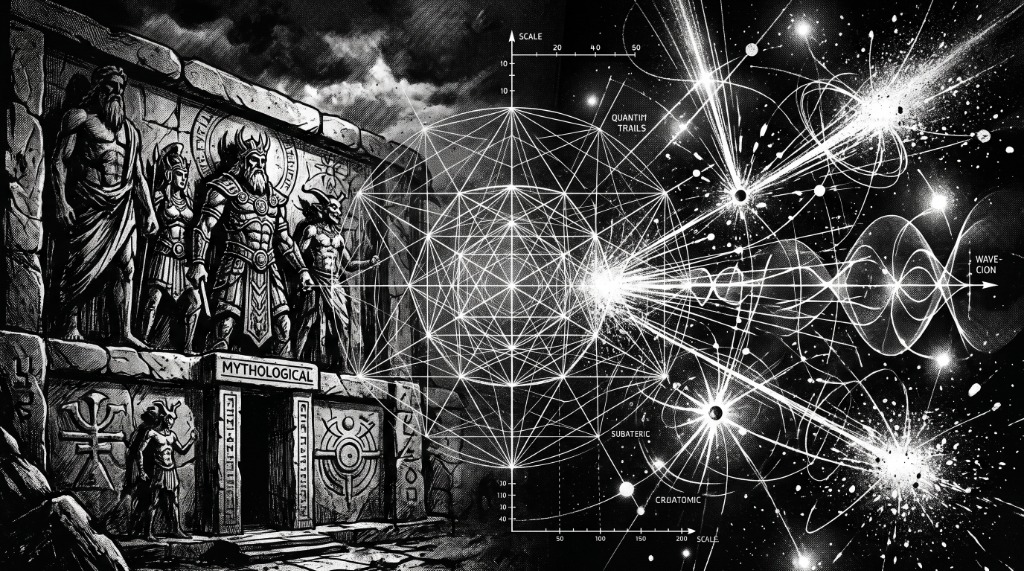
Theoretical Framework: Meta-Abstractions and Substrate Independence
To transition this intuition from speculative philosophy to computational investigation, the hypothesis must be stated in falsifiable, structural terms: a generative intelligence may be detectable not as a doctrinal proposition, but as a recurring topological pattern across independent substrates.
Whereas a metaphysical proposition demands binary acceptance or rejection, a structural pattern permits quantitative measurement. One does not debate the validity of an architectural blueprint; one maps its load-bearing joints, measures its relational invariants, and tests whether identical design primitives recur across decoupled systems.
Evaluating this hypothesis without drifting into semantic ambiguity requires a formal unit of analysis. We define a meta-abstraction as an invariant architectural or algorithmic device instantiated across two or more structurally orthogonal domains to resolve analogous functional constraints.
A meta-abstraction is strictly distinct from literary metaphor, pareidolia, or superficial analogy. It represents an isomorphic or homomorphic mapping between relational graphs operating on distinct physical or informational substrates. Formally, if Domain A and Domain B exhibit disparate surface ontologies, a meta-abstraction exists when a transformation f: G_A \rightarrow G_B preserves key topological invariants, constraint-resolution mechanisms, and state-transition dynamics.
This analytical model decomposes every candidate system into three operational tiers:
- Surface Layer (Substrate Ontology): The domain-specific vocabulary, cultural nomenclature, physical scale, or material composition that varies completely across systems.
- Structural Layer (Architectural Device): The underlying relational topology, symmetry-breaking mechanisms, boundary conditions, and state-mediation protocols that persist across substrates.
- Falsification Criterion: Do orthogonal systems resolve structural instability, state transformation, and interaction mediation using statistically convergent topologies?
If cross-domain embedding spaces yield random or uniformly distributed nearest-neighbor topologies, the hypothesis is falsified. Conversely, if non-trivial structural clustering emerges across independent domains, the signal warrants systematic topological mapping.
Comparative Mythology as a Graph-Theoretic Domain
Traditional comparative mythology frequently suffers from excessive dimensionality at the lexical surface. Philologists, historians, and anthropologists devote substantial effort to cataloging regional nomenclature, geographic diffusion, priestly redactions, and diachronic linguistic drift. While essential for historical reconstruction, these surface variables introduce high-variance noise when analyzing underlying structural mechanics.
To isolate structural topology from lexical variance, the syncretica platform was engineered within Project Cinderblock. Built as an open-source, locally hosted Ruby on Rails computational research environment for comparative religionists, archaeologists, and mythologists, syncretica models pantheons, ritual traditions, and narrative mythemes as structured relational entities. Rather than treating mythological corpora as unstructured prose, the system encodes functional attributes and relational roles into 1024-dimensional dense vector representations stored via pgvector.
Through its Model Context Protocol interface, syncretica-mcp, analytical pipelines execute cross-tradition vector searches, compute cosine-distance counterpart lookups (find_counterparts), and perform connected-components graph clustering across parameterized similarity thresholds.
When mythological entities are projected into high-dimensional metric spaces, several empirical regularities emerge:
- Cross-Cultural Structural Counterparts: Deities and narrative agents separated by geographic isolation and historical discontinuity occupy proximate neighborhoods in \mathbb{R}^{1024} because they fulfill invariant relational roles within their respective cosmological graphs.
- Mythemes as Modular Primitives: Narrative operators such as cosmogonic sacrifice, liminal threshold mediation, stochastic trickster perturbation, and cyclical state renewal function less as arbitrary folklore and more as standardized architectural modules parameterized by local cultural variables.
- Convergent Narrative Topologies: When culturally isolated societies converge on identical relational architectures without documented lines of transmission or diffusion, those structures behave as invariant solutions to narrative constraint satisfaction.
In computational terms, the surface lexical tokens vary, while the underlying functional signature remains invariant.
Subatomic Physics and Structural Economy
Because mythology is an artifact of human cognition, any structural convergence observed within syncretica remains vulnerable to a neurobiological null hypothesis: shared human cognitive architecture naturally generates shared narrative motifs. To test whether meta-abstractions exist independently of human neurobiology and cultural evolution, the analytical framework must be extended into non-anthropogenic physical systems.
Standard particle taxonomy prioritizes descriptive precision, partitioning subatomic phenomena by invariant rest mass, electric charge, spin angular momentum, and fundamental interaction couplings. While this taxonomic hierarchy accurately assigns particles to discrete classifications, it is not designed to measure whether entities across distant taxonomic branches utilize analogous structural mechanisms to maintain stability or mediate interactions.
To evaluate physical systems using the exact same geometric methodology applied to comparative mythology, physicist and its companion server physicist-mcp were developed within Project Cinderblock. The platform models physical phenomena across a three-tier ontological hierarchy: particle families, individual subatomic particles, and discrete quantum states or eigenmodes. Each entity and state is projected into a 1024-dimensional pgvector space and processed through the identical connected-components clustering engine and immutable snapshot pipeline.
Projecting subatomic entities into continuous metric manifolds reveals non-obvious structural alignments across standard classifications:
- Cross-Taxonomic Topological Proximity: Connected-components clustering groups entities from distinct taxonomic branches when they exhibit analogous behavior in gauge mediation, symmetry preservation, or instability resolution.
- Isomorphic Constraint Resolution: Disparate physical families resolve boundary constraints (such as color confinement, radiative decay pathways, phase transitions, and conservation laws) through parallel structural dynamics.
- Architectural Parsimony: Rather than generating bespoke structural rules for every taxonomic category, physical systems demonstrate an economy of design primitives, reusing core topological devices across disparate energy scales and interaction regimes.
The structural parsimony observed in comparative narrative graphs recurs within subatomic state spaces, manifesting not as subjective metaphor, but as measurable proximity within a shared metric geometry.
Computational Methodology: Metric Manifolds and Multi-Agent Orchestration
Human cognition exhibits a strong bias toward apophenia, frequently projecting false-positive patterns onto stochastic noise. Eliminating observer bias in cross-domain structural analysis requires two methodological shifts: replacing rigid hierarchical taxonomies with continuous vector manifolds, and replacing monolithic conversational prompts with deterministic, isolated multi-agent harnesses.
Metric Manifolds Versus Hierarchical Taxonomies
Classical scientific taxonomies rely on tree structures. Once a branching criterion partitions two entities at an upper node, those entities remain permanently separated in the hierarchy, regardless of how closely their downstream functional dynamics align.
High-dimensional vector embeddings overcome this structural rigidity. By mapping mythological constructs in syncretica and subatomic eigenmodes in physicist into 1024-dimensional continuous manifolds, cosine similarity (S_C(\mathbf{A}, \mathbf{B}) = \frac{\mathbf{A} \cdot \mathbf{B}}{|\mathbf{A}| |\mathbf{B}|}) quantifies functional proximity independent of categorical labels. Executing connected-components clustering across 15 discrete granularity thresholds (\epsilon_1, \dots, \epsilon_{15}) enables researchers to vary graph density systematically, freeze immutable database snapshots, and audit cluster membership empirically prior to interpretive synthesis.
Deterministic Multi-Agent Orchestration
Generating topological clusters represents only the initial data-extraction phase. Auditing dozens of immutable snapshots, traversing cluster subgraphs, and compiling multi-stage synthesis reports (such as 2-Phase Map-Reduce or 3-Phase Hierarchical Deep Synthesis monographs) rapidly exceeds the effective context capacity of monolithic language model sessions. Exposing dozens of heterogeneous tool schemas simultaneously degrades attention allocation, induces schema hallucinations, and compromises analytical rigor.
To maintain strict determinism and context hygiene, the research pipeline executes within agent-octopus, a component of Octopus Harness. Built atop Pydantic AI, the Model Context Protocol (MCP), and version-controlled Markdown runbooks (octo-com), the harness converts open-ended cross-domain exploration into a reproducible computational pipeline:
- Version-Controlled Execution Runbooks: Analytical procedures are codified in immutable Markdown workflows rather than ad-hoc prompts, ensuring deterministic execution, auditability, and peer reproducibility.
- Domain-Sandboxed Specialist Isolation: Each specialist agent operates within a strictly scoped tool boundary (such as the 28 domain tools exposed by syncretica-mcp or the 51 analytical tools exposed by physicist-mcp), minimizing context entropy and maximizing reasoning precision.
- Ephemeral MCP Server Lifecycles: Domain servers instantiate dynamically for active specialist execution and terminate immediately upon task completion, preventing state leakage and tool-namespace collisions.
- Asynchronous Shared State Ledger: Validated analytical outputs propagate across pipeline stages through a structured ledger, insulating downstream synthesis agents from raw intermediate traversal noise.
These computational instruments do not manufacture cross-domain homologies; rather, they establish the experimental controls required to measure them at scale.
Epistemological Constraints and the Synthetic Observer
The primary bottleneck in cross-disciplinary structural synthesis is neither computational throughput nor mathematical formalism, but the cognitive and institutional limitations of the human observer.
In practice, it is exceedingly rare to identify a single researcher who possesses both the mathematical rigor of a theoretical physicist and the philological fluency of a comparative theologian, while remaining free of ideological priors from either discipline. This scarcity stems from systemic structural constraints:
- Disciplinary Silos: Physics departments and religious studies faculties operate within disconnected institutional structures, publish in non-overlapping peer-reviewed journals, and respond to divergent funding incentives.
- Reputational Asymmetric Risk: A physicist investigating structural parallels in mythological corpora risks professional marginalization, while a theologian subjecting sacred texts to vector-space decomposition risks doctrinal censure.
- Cognitive Identity Defense: Neurobiological threat-response mechanisms frequently conflate challenges to foundational worldviews with physical threats, triggering motivated reasoning and confirmation bias before cross-domain evidence can be evaluated objectively.
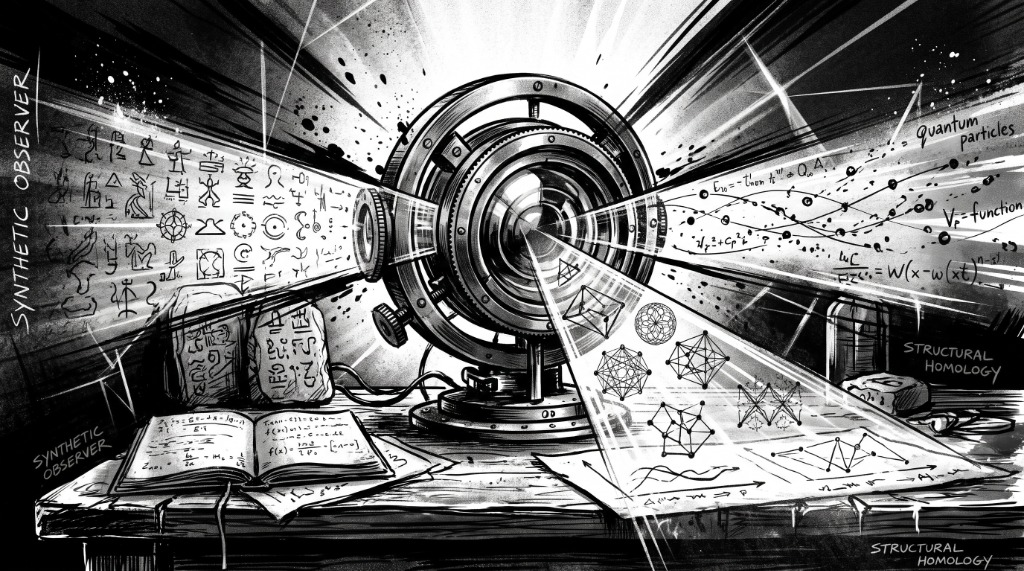
Deterministic multi-agent architectures alter the epistemology of the observer. By coupling domain-isolated MCP laboratories with reproducible runbooks inside agent-octopus, researchers can instantiate a composite synthetic observer: an analytical system capable of simultaneously interrogating astrophysical state spaces and comparative mythological graphs without institutional incentives, ideological priors, or neurobiological defensiveness.
This methodological shift reframes the underlying inquiry from rhetorical debate to empirical falsification. Rather than arguing over competing metaphysical claims, researchers execute repeatable computational experiments across frozen vector snapshots, distance matrices, and structured synthesis monographs. A synthetic observer does not yield an absolute metaphysical proof, and any claim to the contrary misrepresents the scope of computational modeling. Instead, it provides a rigorous analytical instrument that places comparative mythology and subatomic physics onto a unified metric workbench, isolates observer bias, and allows invariant structural logic to be measured directly.