
Modeling Complex Data
Most teams treat Jupyter Notebook as the automatic starting line for any data or AI project. Open a notebook, load a CSV, run a few cells, plot a chart, call it analysis. That reflex works when the world hands you a finished, flat spreadsheet. It breaks the moment your data stops sitting still.
Real-world knowledge work is rarely a clean table. It is not a static CSV, not a finished benchmark, and not a one-off script. It is a living graph of messy sources, evolving definitions, and relationships you only discover halfway through the project.
If your goal is to build an evolving knowledge system rather than run a one-time calculation, a notebook is the wrong foundation. Ruby on Rails paired with PostgreSQL, pgvector, and LLM-driven extraction gives you something a notebook never will: a durable domain model that grows smarter every time you feed it new reality.
The Notebook Default and Its Ceiling
Jupyter earned its reputation for a reason. A notebook interleaves executable code, narrative text, equations, and plots inside a single .ipynb JSON document. When you already have a curated, rectangular dataset and want to run linear, procedural analysis, nothing beats that feedback loop.
The ceiling appears when the shape of the problem changes. Notebooks assume three things that fail on complex knowledge domains:
- Flat inputs: Dataframes expect rows and columns with uniform fields. Once entities link to other entities in many-to-many webs, forcing them into flat tables creates brittle join logic scattered across cells.
- Linear execution: A notebook runs top to bottom. In practice, practitioners jump around, mutate variables out of order, and end up with hidden state that no longer reproduces from a fresh kernel.
- Static schemas: Notebooks are built to consume datasets that someone else already cleaned and froze. They are poor containers for data that is still being discovered, corrected, and expanded every week.
The friction shows up in your own bandwidth. Instead of asking harder questions about the domain, you spend your energy fighting stale kernels, duplicating transformation cells, and wondering which copy of clean_v4_final.csv produced last Tuesday’s result.
Notebooks are great scratchpads. They are terrible databases.
Why Model Complex Relationships in Rails
When the data itself is graph-shaped and evolving, you need to model the structure directly instead of waiting for an already-curated dataset to appear.
This is where Active Record earns its keep. Rails forces you to name your entities, declare how they connect, and enforce rules before anything touches disk. You do not need a specialized graph database to start modeling a complex web of knowledge. Standard relational primitives in PostgreSQL and Active Record Associations cover the vast majority of real-world graph structures:
- Entities as first-class models: Every core concept gets its own table, attributes, and validation rules rather than living as an untyped dictionary key inside a Python cell.
- Explicit relationships as join models: Instead of burying links inside JSON blobs, you represent edges as real records (with relationship types, weights, notes, and timestamps).
- Schema evolution as a habit: Active Record Migrations turn structural changes into versioned, repeatable steps. When your understanding of the domain sharpens, the schema adapts cleanly without invalidating prior work.
- Integrity at the boundary: Validations catch malformed records, missing foreign keys, and duplicate entities before bad data poisons downstream analysis.
Modeling the structure changes how you think. You stop treating data as disposable script output and start treating it as an operational asset.
The schema is not bureaucracy. The schema is the model.
LLM Extraction as a Data-Building Engine
Historically, building a rich relational dataset from unstructured sources took months of manual entry. Most solo builders skipped modeling altogether because the ingestion cost was too high.
LLMs invert that cost curve. You can treat an LLM not as a chatbot, but as a structured extraction engine that turns raw prose (books, papers, transcripts, primary texts, field notes) into typed entities and explicit links inside your Rails database.
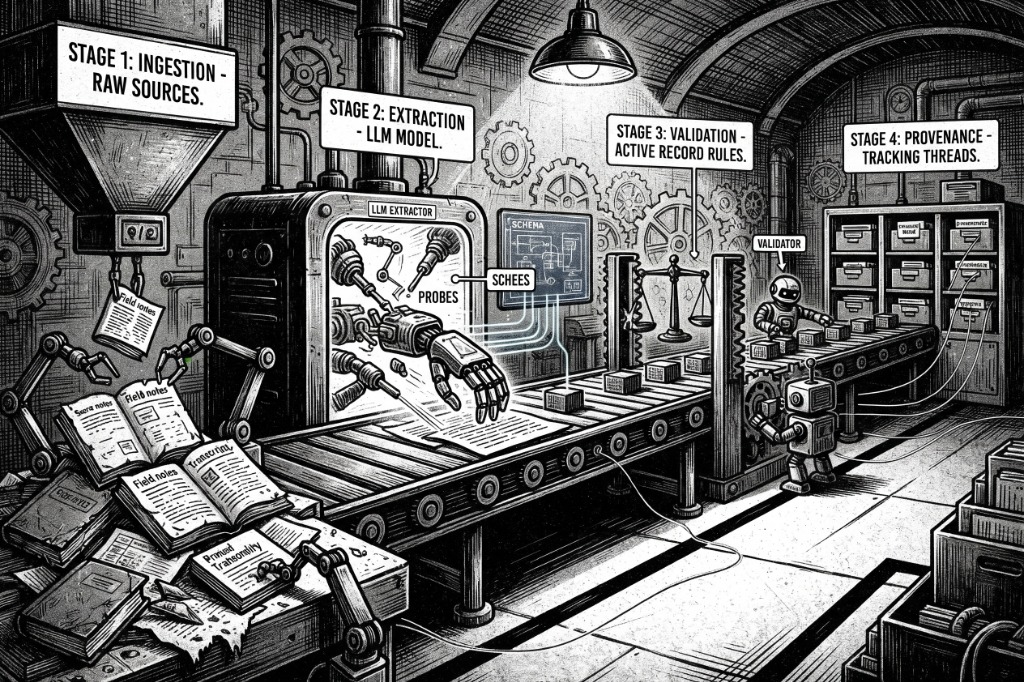
To keep that pipeline grounded in reality rather than hallucination, separate the work into four operational layers:
- Ingestion: Capture raw unstructured sources as immutable records first. Never throw away the source text after extraction.
- Extraction: Prompt an LLM with a strict target schema to propose entities, attributes, and relationships from each source chunk.
- Validation: Pass every extracted record through Active Record validations, deduplication checks, and domain constraints before committing it to the graph.
- Provenance: Store where every claim came from (source record, excerpt, model version, and extraction timestamp). When an assumption looks questionable three months later, you can trace it straight back to the original passage.
This turns data modeling into an iterative loop. You ingest a batch of sources, inspect where the schema feels cramped, write a migration to add a new association or attribute, and re-run extraction on targeted records. Each pass tightens contact with the source material.
The loop is the engine. Provenance is what keeps it honest.
Finding Patterns with Agents + RAG
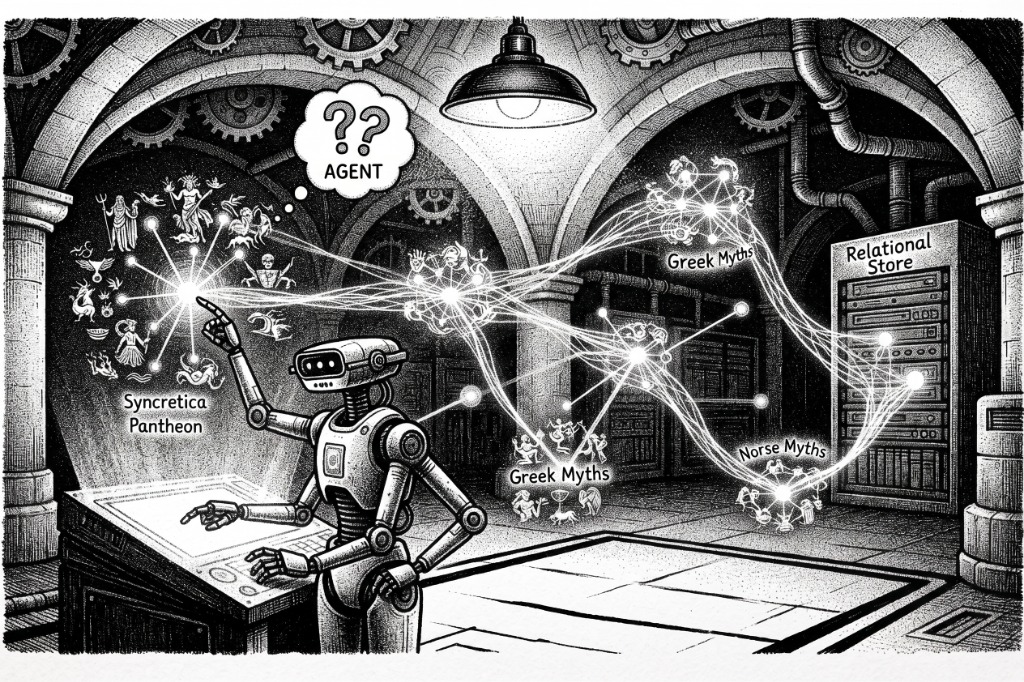
Once your entities, cross-links, and provenance live in PostgreSQL, adding pgvector turns the same database into a semantic search engine. With Rails gems like Neighbor, vector columns sit right next to your relational fields and foreign keys. You do not need a separate vector database or a fragile sync pipeline to keep embeddings aligned with your records.
That single-store architecture unlocks hybrid retrieval that flat RAG pipelines cannot match:
- Semantic entry points: Embeddings let you find conceptually similar records even when the exact keywords never overlap.
- Relational traversal: Once a vector query lands on relevant nodes, standard Active Record queries walk the graph (following foreign keys, join models, and shared attributes) to pull in exact structural context.
- Filtered similarity: Because vectors live inside PostgreSQL, you can combine exact nearest-neighbor or approximate indexed search (HNSW or IVFFlat in pgvector) with standard SQL filters in one query.
Put an agent on top of this stack, and the mode of exploration shifts completely. You are no longer writing procedural notebook code to test one hypothesis at a time. You query and traverse the knowledge graph conversationally. An agent can run a semantic search, inspect the linked entities, pivot across a join table to compare two clusters, check the underlying source provenance, and surface candidate patterns on demand.
Procedural code answers the question you already knew how to formalize. An agent over a modeled graph helps you discover the questions you did not know to ask.
Syncretica as a Case Study
Comparative mythology is a textbook stress test for data modeling. It is messy, overlapping, full of regional variants, and stubbornly resistant to flat spreadsheets. A single deity might appear under three names, belong to shifting pantheons, share structural motifs with figures across an ocean, and carry contradictory attributes depending on the era and source text.
Syncretica approaches this problem with Rails 8 and PostgreSQL powered by pgvector. Instead of flattening mythological material into a static table, it models the domain directly:
- Structured domain entities: Gods, pantheons, and myths exist as distinct, connected models rather than loosely tagged rows.
- Explicit cross-links: Relationships between figures, traditions, and narratives are represented directly in the relational layer, preserving how stories and roles intersect across cultures.
- Vector embeddings on modeled knowledge: Each entity and myth carries semantic embeddings alongside its structured fields, encoding meaning beyond surface-level names and keywords.
- Vector clustering for pattern discovery: Clustering across the embedding space surfaces non-obvious connections between deities and myths from separate traditions. When two figures from distant pantheons land in the same cluster despite sharing zero proper nouns, the system hands you a concrete lead worth investigating.
A flat notebook could count how many times a word appears in a corpus. A modeled Rails graph with embeddings and clustering lets you navigate structural parallels across entire mythologies and verify every connection against the relational record.
Choosing the Right Tool
This is not an argument to delete Jupyter. Tool tribalism is just another form of avoidance. Each environment solves a different class of problem, and knowing where one stops and the other starts saves weeks of wasted effort.
Split the choice by what you are actually building:
- Use Jupyter Notebooks for statistical analysis and visual inspection: Quick exploratory statistics, distribution checks, regression tests, dimensionality reduction, and publication plots over a bounded snapshot of data.
- Use Rails + AI for evolving, relational knowledge: Domains with rich entities, dense cross-links, ongoing LLM extraction, provenance tracking, semantic retrieval, and agent-driven exploration.
The strongest setup is not either-or. It is a pragmatic two-stage workflow that uses each tool where it has real leverage:
- Build and maintain the source of truth in Rails: Run your LLM extraction jobs, enforce schema rules through Active Record, store embeddings in PostgreSQL with
pgvector, and let agents traverse the live graph. - Export targeted slices into Jupyter when you need math or visuals: Query a clean subset of entities, link counts, or embedding vectors from PostgreSQL, pull them into a notebook for clustering diagnostics, statistical verification, or visual plotting, and then feed any structural discoveries right back into your Rails migrations and models.
Stop forcing notebooks to act like application backends, and stop forcing web frameworks to act like plotting canvases. Put the living knowledge graph in Rails. Put the statistical lens in Jupyter. Keep what survives contact with real data.