
The Revitalization of Legacy Codebases
When a software system approaches a state of architectural stagnation, engineering paradigms traditionally dictate an expensive expansion of product capabilities. Development life cycles become consumed by the implementation of database migrations, controller action modifications, and extensive debates regarding front-end state management. This methodology is predicated on the assumption that adding novel workflows will rejuvenate the application.
However, this heuristic is fundamentally flawed. Contemporary software systems are rarely constrained by an insufficiency of features; rather, they suffer from a deficit of compositional interoperability.
In most mature systems, the underlying databases already retain the necessary state, and application programming interfaces (APIs) rigorously enforce domain-specific business logic. The perception of rigidity within these applications arises because human operators must mediate every interaction through inflexible, precompiled graphical user interfaces (GUIs). Workflows that were not explicitly predefined by software architects remain inaccessible, effectively trapped behind a barrier of missing interface layers.
The Model Context Protocol (MCP) offers a methodological solution to this architectural bottleneck by facilitating interoperability without necessitating any modifications to the core application source code. Functioning not as a system rewrite or a precarious webhook configuration, an MCP server operates as a lightweight, standardized translation layer. This semantic layer exposes existing API endpoints, data schema, and operational sequences directly to autonomous reasoning hosts, including environments such as Claude Desktop, Claude Code, Cursor, and Google Antigravity.
By wrapping established back-end services in MCP servers, developers can foster emergent computational functionalities. This principle is empirically demonstrated by two production-grade servers engineered for an Open-Source Intelligence (OSINT) infrastructure: the macronx-mcp and wikidata-mcp projects.
The Neurological and Architectural Cost of Feature Creep
To understand the efficacy of MCP, one must first analyze the systemic friction associated with traditional application expansion. For example, integrating a localized intelligence intake mechanism with a historical knowledge graph to cross-reference OSINT reports against corporate ownership structures typically induces substantial architectural strain.
In standard development frameworks, this integration necessitates extensive systemic modifications:
- Back-end Coupling: Developers must embed custom HTTP clients, authentication mechanisms, and retry logic within the primary web architecture to enable inter-service communication.
- Schema Hypertrophy: This involves the integration of external entity identifiers into databases not originally structured for such data, requiring the addition of join tables, caching layers, and asynchronous background processors.
- Front-end Proliferation: Engineers are forced to design search modalities and split-screen interfaces to accommodate workflows of statistically low frequency.
The limiting factor in this paradigm is human cognitive capacity, rather than computational or coding velocity. The continuous maintenance of mental state across multiple repositories, divergent database schemas, and fragile API adapters substantially elevates cognitive load and threat baselines.
When integration protocols saturate human cognitive limits, engineers typically exhibit avoidance behaviors, either abandoning complex integration concepts or resorting to manual data transfer methodologies that rapidly induce attention fatigue. Consequently, software platforms deteriorate due to the unsustainable cognitive taxation required to manually bridge disparate systems. MCP fundamentally eliminates this translational tax.
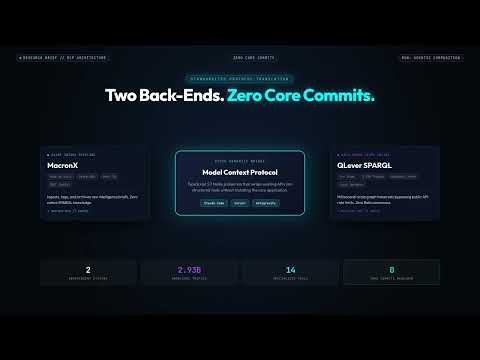
Architectural Implementation: Two Back-ends, Zero Core Commits
The empirical validity of this approach is evidenced by the integration of two distinct systems within the macron1-automations intelligence environment:
- MacronX: A customized OSINT intake pipeline constructed using the Ruby on Rails framework and a PostgreSQL relational database. It incorporates a Rust-based terminal user interface (
macronx-tui) and functions by ingesting, tagging, and routing raw intelligence through language models before archiving structured briefs within an authenticated RESTful API (/api/v1). - QLever SPARQL Engine: A self-hosted graph database index comprising approximately 2.93 billion Wikidata Truthy triples. Designed for rapid, millisecond-scale graph traversals on local hardware, this engine circumvents the structural rate limits characteristic of public APIs.
Crucially, neither system possesses intrinsic awareness of the other; MacronX lacks a SPARQL client, and the QLever engine has no interfacing capabilities with Rails applications. Instead of structurally mutating these existing systems, autonomous interoperability was achieved by deploying two independent MCP servers developed in TypeScript 5.7 on the Node.js runtime. Both implementations were bundled utilizing tsup, validated through the Vitest framework, and configured to communicate via standard standard input/output (stdio) streams.
This architectural synthesis involved exposing specific capabilities without altering PostgreSQL schemas, Ruby on Rails routing protocols, or the QLever index. Each server surfaces seven specialized MCP tools. For macronx-mcp, these comprise functions such as inbox creation, retrieval, and archiving. Conversely, wikidata-mcp exposes graph-traversal functions including entity grounding, cross-link discovery, and a direct SPARQL querying endpoint.
The integration of these two independent modules within a unified MCP host instantly activated synergistic capabilities that neither application was initially engineered to execute.
Emergent Composition and Autonomous Interoperability
Conventional graphical interfaces artificially restrict user interactions to explicitly designed pathways. However, translating functionalities into MCP tools and resources transforms the host artificial intelligence into a dynamic, runtime compositional engine. By concurrently initiating macronx-mcp and wikidata-mcp within an environment like Cursor or Google Antigravity, complex, novel workflows emerge organically.
Demonstrated operational synergies include:
- Automated Claim Verification: An autonomous agent can invoke inbox retrieval tools on the macronx-mcp server to parse raw intelligence documents. It can seamlessly pipe contested assertions regarding geopolitical treaties or corporate structures into the verification tools of the wikidata-mcp server. If the external claims deviate from the established 2.93-billion-triple graph, the agent autonomously highlights the mathematical anomaly and updates the intake pipeline.
- Multimodal Entity Resolution: Utilizing attachment extraction functions, the agent analyzes visual data from OSINT reports to identify infrastructure or specific insignia. The parsed metadata is then transmitted to the entity resolution functions within wikidata-mcp to immediately retrieve associated regional participants via outbound and inbound semantic relations.
- Second-Order Network Discovery: Agents can batch-process archived reports from MacronX, ground the extracted entities within the local Wikidata graph, and logically compute overlapping institutional hubs that were not explicitly documented in any single report.
These sophisticated network integrations manifest spontaneously, demonstrating that protocol-driven composition yields vastly more generative and robust outcomes than hardcoded integrations.
The Leverage of API-Constrained Agentic Development
Directing autonomous AI coding agents to construct novel software architectures frequently results in systemic inconsistencies. Devoid of strict constraints, language models may hallucinate structural requirements or design inherently flawed database schemas. In stark contrast, deploying these same agents to interface with established API endpoints yields highly deterministic results.
Pre-existing API frameworks provide rigid mathematical constraints, such as immutable HTTP verbs, structural authentication requirements, and predefined RDF triple hierarchies. This strict parameterization offers significant scientific benefits:
- Zero-Ambiguity Scaffolding: AI agents leverage existing controller routes or OpenAPI specifications to automatically generate accurate client architectures, complete with robust test suites.
- Agent-Ergonomic Middleware: While human developers engineer wrappers for human consumption, AI models optimize for context-window economics. For instance,
macronx-mcpfeatures payload truncation mechanisms, automated ten-second Time-To-Live (TTL) caching for tag translation, and strict environmental read-only locks to prevent unintended mutations. - Composite Abstraction over Raw Queries: Rather than computing raw SPARQL statements for every request, high-frequency cognitive operations are dynamically aggregated to conserve token throughput and prevent syntax vulnerability. The
wikidata-mcpserver incorporates a clamped 500-row limit on raw queries while routing standard tasks through composite tools that efficiently filter domain classes and pull outbound network triples.
Automated Discovery and Multi-Step Cognitive Protocols
A frequently overlooked facet of the MCP specification involves the synergistic deployment of Guided MCP Prompts and MCP Resources. While human engineers tend to conceptualize APIs in terms of isolated Create, Read, Update, and Delete (CRUD) operations, autonomous AI systems excel at synthesizing comprehensive, multi-step analytical routines across an entire architectural topology.
This phenomenological distinction is evident in the guided workflows generated for both servers. The triage prompts autonomously coordinate resource retrieval and classification protocols for macronx-mcp without manual initiation. Similarly, the enrichment workflows within wikidata-mcp were transformed from a rudimentary lookup function into an automated editorial pipeline that grounds textual entities, tags canonical QIDs, and injects structural metadata in strict accordance with predefined enrichment algorithms.
The compilation of these multi-step cognitive frameworks directly into the server eliminates operational friction and drastically enhances system discoverability. Operators seamlessly execute complex orchestration processes by invoking these protocols, allowing the artificial intelligence to dictate the optimal sequence of algorithmic tool calls.
Strategic Implementation: The Four-Layer Analytical Stack
For engineering teams maintaining functional legacy infrastructures, the empirical imperative is to cease superfluous user interface development and adopt an optimized four-layer analytical stack:
- Foundational Constraints: Conduct rigorous audits of existing RESTful, GraphQL, or SPARQL endpoints, ensuring authentication and error-handling mechanisms are unequivocally deterministic.
- Algorithmic Leverage: Utilize autonomous coding environments to scaffold explicit TypeScript or Ruby-based MCP wrappers that abstract repetitive functional sequences into composite execution tools.
- Systemic Stability: Implement strict state-mutation guardrails, including context-window payload truncation, static lookup caching mechanisms, and immutable read-only parameters to protect relational databases from unintended AI behavior.
- Architectural Reductionism: Systematically eliminate bespoke administrative interfaces and hardcoded webhook integrations. Instead, domain dictionaries should be exposed strictly as MCP Resources to facilitate agentic orchestration.
By encapsulating existing software architectures in standardized MCP environments, developers can actualize the latent computational potential already present within their systems, avoiding theoretically unnecessary structural rewrites.